
Your free menstrual period & cycle tracking app may be failing you
Before I learned how to track my cycle using Fertility Awareness (this is 8+ years ago), I tracked my period using the first fertility app I could find.
I had no idea how much information I was missing.
Now, as a Fertility Awareness Educator, many clients come to me curious about the latest technology that doesn’t just log period dates, but claims to predict when you’re fertile.
If this is you, reader, I hate to break it to you…
…these apps may be giving you false cycle confidence.
The algorithm assumes
Many popular fertility apps rely heavily on algorithms, or mathematical predictions, based on your past cycles, past research,and other users.
But the truth is, your cycle is unique to you…and it’s not the same month to month because life happens.
Let’s break down some examples.
Your menstrual-ovulatory cycle is influenced by stress, sleep, nutrition, illness, and more - and this fluctuation is both common and normal.
Any app that is using your past cycles to make predictions about the present is inherently going to be less accurate than a method that is using day-to-day observations.
If you’re only using an app, you’re missing the nuanced reality of your cycle in the present tense.
Ovia Health uses an algorithm that compares your data to other users
Your cycle is just that: yours. And not only does your cycle vary day to day, it’s not necessarily similar to others in your age range.
Apps may be operating with data about the “textbook” cycle length of 28 days and a fertile window of 6 days as a starting point.
But a 2020 study of 32K+ women found that only 12.4% of participants had a ‘textbook’ 28-day cycle, and over 52% of participants had cycles that varied by 5 days or more.
The data also suggests that the ‘standard’ 6-day fertility window is not accurate for everyone. A 2008 study found a wide variable in fertile days: the average length was 5 days (with 11.8% of cycles with an exact fertility window of that length), and the. most common fertile window was 3 days (21% of cycles).
When you’re tracking your cycle, it’s personal and should be truly bespoke.
Natural Cycles cites a study that claims that “most sexually active women without features of subfertility…successfully got pregnant within two cycles”
Dive deeper into this study, and you’ll see the the group with the greatest success were those under 35 with regular cycles (that had less than 5 days of variation).
But variable cycle length is not necessarily feature of ‘subfertility’!
This is why moving beyond an app can be a game-changer for folks who are trying to conceive. It’s not that you’re ‘subfertile’… it’s that the app isn’t looking at you and only you.
Apps & Ovulation
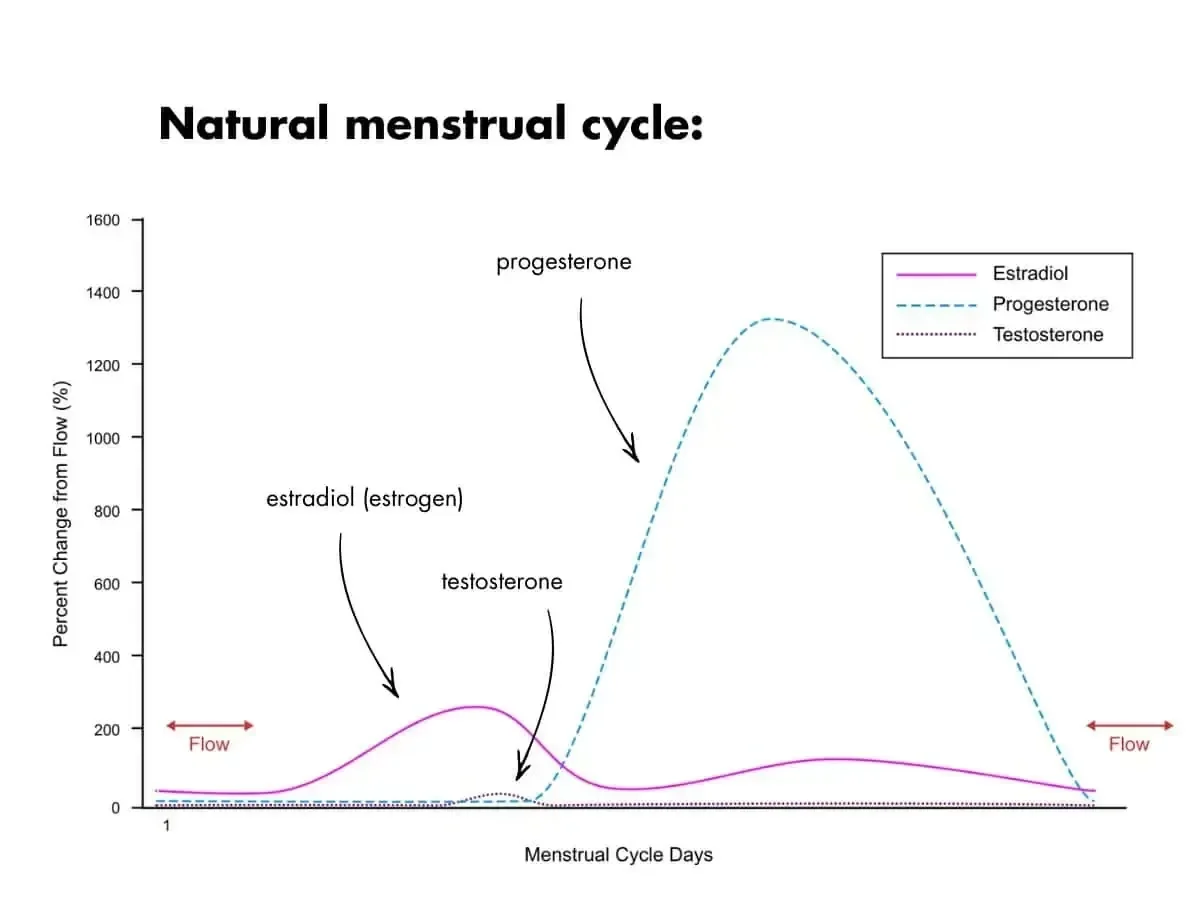
Image from LaraBriden.net
Ovulation is the result of a complex hormonal cascade that is influenced by a range of physiological factors (and just because you’re bleeding doesn’t mean you’re ovulating).
This the issue that apps cannot overcome: apps cannot predict ovulation. That’s between you and your body, babe.
Fertility Awareness Method does not pretend to predict ovulation. The sympto-thermal method I teach shows clients how to determine ovulation in retrospect - and data suggests that 91% of the time, users of this method can estimate their ovulation within 2 days.
That kind of accuracy can make a world of difference, given that a study in 2015 found that ovulation (as determined by ultrasound) in participants ranged from Day 8 to Day 26.
This is where the apps do not fare as well.
A 2018 study found that the accuracy of ovulation prediction by apps was no better than 21%.
Let’s get into some more examples:
Clue calculates ovulation by counting backwards 13 days from your next predicted period
Not everyone has a ‘textbook’ 13 day luteal phase! I see this all the time in my practice.
And whether you’re trying to conceive or trying to avoid… knowing when ovulation occurs is key.
The app Glow uses customer real-time logs and a “slew of other data” to determine your ovulation window (it doesn’t specify what kind)
What kind of ‘slew’ of data are we talking about here?
This is where I love Fertility Awareness: the practice is simple, and uses just two biomarkers that are assessed in under 5 minutes a day.
It’s not a data slush pile.
Privacy risks for your most intimate data
Beyond accuracy lies the concern around privacy.
Tracking your cycle is incredibly intimate. It can include information about your sexual activity, mood changes, pregnancy intentions, and and more.
Your chart creates a vivid, detailed profile of your reproductive and personal life… data that is incredibly valuable to certain companies
A 2019 study by Privacy International found that many popular apps were sharing user data with Facebook and other third parties - sometimes without users’ consent.
These right to privacy issues get more complex depending on access to reproductive care in your area.
The personalization paradox
Many fertility apps claim to ‘learn’ your patterns over time and adjust their predictions based on your tracked data.
Yes! But that means these apps suffer if you:
Are inconsistently logging symptoms
Forgetting to track certain days
Not understanding what symptoms are actually relevant
This means that without informed user engagement, the algorithm could be making predictions based on incomplete or inaccurate information.
Let’s go through some more examples.
Apps like Natural Cycles rely on basal body temperature (BBT), a key indicator of whether ovulation has occurred.
Absolutely! The method I teach also relies on BBT. But there are some key notes about the temperature practice that are vital for its successful.
Basal body temperature has to be taken at the same time each morning, first thing! If you don’t, those temperatures may not be accurate.
Not to mention there are many factors that can affect your temperature: traveling, lack of sleep, etc.
In my Natural Birth Control & Hormone Health Charting Course we cover all of these situations so that my students are prepared for other real-world scenarios and can make decisions that align with their goals accordingly.
Natural Cycles offers the Oura Ring is an alternative to using a basal body thermometer
My clients love their Oura Rings. I get it! But there are a few things you should know about its use, especially if you’re trying to avoid.
The Oura Ring is NOT taking your basal body temperature, just a distal temp (on your finger).
Again, when tracking your cycle, specificity matters.
If I have a client in my class who wants to use an Oura Ring, I usually suggest tracking alongside BBT to make sure that these temperatures are lining up and it aligns with their goals.
In my Natural Birth Control & Hormone Health Charting Course, we cover all kinds of situations like these and discuss how to adjust protocols accordingly so my students can be self-sufficient.
Which brings me to…
Self-sufficiency
My mission as a Fertility Awareness Educator is to make my students self-sufficient.
I teach my students to rely on their internal technology of observation… rather than relying on an external technology to do it for them.
That’s why the learning curve is worth it to me and so many students I’ve worked with: when you take the time to read the signals your body is sending you, you develop an intimate understanding that no external tool can provide.
Cycle Tracking puts you in touch with your body in a more intentional and fluent way.
You become the expert in your own fertility and can make informed decisions based on real-time observations rather than obeying an app.
P.S. With all this said, the only app that I currently recommend given these privacy concerns is Read Your Body, which is not ‘predictive’ and does not see, share, sell or do anything with your data - all participants in my Natural Birth Control & Hormone Health Charting Course + my Charting to Conceive Charting Course receive three free months of access to Read Your Body!
